Roasting is where coffee picks up its personality. The same green bean can come out bright and fruity or deep and chocolatey, depending on how far the roaster takes it. Neither end is the right answer. There is no rule against a light roast at 6 a.m. and something darker after lunch. Here is how light roast vs dark roast really compares, where medium roast fits, and how our coffees line up on the pitch scale.
What roasting does to a coffee bean
Raw coffee, called green coffee, is a hard, dense seed that smells more like cut grass than anything you would want in a mug. Roasting is what turns it into coffee.
As the beans heat, they dry out, shift from green to yellow to brown, and swell while losing weight. Sugars and amino acids react and brown, building the sweet, nutty and roasty flavors we know as coffee. Partway through, the beans pop out loud, a stage roasters call first crack. Keep going and a quieter, snappier second crack follows.
Where the roaster stops sets the roast level:
- Light roasts come out during or shortly after first crack.
- Medium roasts go further, landing between first and second crack.
- Dark roasts are taken near or into second crack, which is often when oils start to show on the surface.
The longer the roast, the more the bean’s original character gives way to roast character. Same house, different pitch, very different job.
Light roast vs dark roast: flavor, body and acidity
Three words do most of the work when people describe coffee. Body is how heavy it feels in your mouth, from tea-light to syrupy. Acidity is the bright, crisp snap in the cup, like biting a green apple. It is not the same as sour. Flavor is everything else you taste. Here is how all three move as the roast gets darker.
Light roast coffee
Light roast beans are light brown with a dry surface. They hold on to more of the character that comes from where the coffee was grown and how it was processed, so you get notes like fruit, citrus, flowers and tea. Acidity is at its brightest and the body is lighter. Because the beans are denser, they give up their flavor less easily. Brewed too cool or ground too coarse, a light roast can taste sour or thin.
Medium roast coffee
Medium roast coffee sits in the middle. The bean is a fuller brown, sweetness steps forward, and flavors lean toward caramel, chocolate and nuts with some brightness still behind them. Body fills out and acidity softens. Medium roasts are forgiving in almost any brewer, which makes them a safe call for a crew with mixed tastes.
Dark roast coffee
Dark roast coffee runs from deep brown to nearly black, often with an oily sheen. Roast flavor takes the lead: dark chocolate, caramelized sugar, toasted nuts and sometimes a smoky edge. Acidity drops, body gets heavy, and the finish runs bittersweet. The trade-off is that origin character gets harder to pick out. Dark roasts also extract fast, so a grind that is too fine or a brew that runs too long can push them toward harsh.
Does dark roast have more caffeine?
This one starts arguments at the supply house. The short answer is not really. Roasting changes caffeine very little, so light, medium and dark roasts land close together.
What roasting does change is the bean. It loses water and mass and puffs up, so a darker bean is lighter and less dense than a lighter one. If you measure with a scoop, a scoop of light roast can hold slightly more coffee by weight than the same scoop of dark roast, which can mean a little more caffeine in that cup. Weigh your coffee instead and most of that gap closes.
The bold taste of a dark roast is flavor, not extra kick. What moves strength and caffeine the most is how much coffee you use, how much water you pour, and how you brew it. Want a stronger cup? Add coffee or cut water. A coffee-to-water ratio of 1:15 to 1:17 by weight is a common starting point, and the coffee ratio calculator does the math for any cup size.
Matching the roast to the brew method
Any roast works in any brewer. Some pairings just play to each roast’s strengths.
- Pour-over shows off light roasts. The paper filter makes a clean cup, so fruit and floral notes come through clearly. Try Skylight or Starter Strip with our pour-over guide.
- Drip coffee is the all-rounder and a natural home for medium roasts. The drip coffee guide covers getting a machine dialed in.
- French press keeps oils and fine particles in the cup, which suits the heavy body of medium-dark and dark roasts. Follow the French press guide with The Tear-Off.
- Cold brew turns medium and dark roasts smooth and chocolatey over a long, cold steep. Storm Chaser is a good place to start, and the cold brew guide has the steps.
Two tweaks help with any method. Water between about 195°F and 205°F is a common starting point; light roasts usually do better toward the hot end and dark roasts toward the cooler end. Grind a touch finer for light roasts and a touch coarser for dark ones, then taste and adjust. More methods live in the Jobsite Brew Guide.
Our lineup on the pitch scale
We rate every coffee with a pitch rating, borrowed from roof pitch: rise over a 12-inch run. The higher the pitch, the darker the roast and the bolder the cup. Light starts at 4/12 and the darkest, Ridge Cap, sits at 11/12. From low slope to steep:
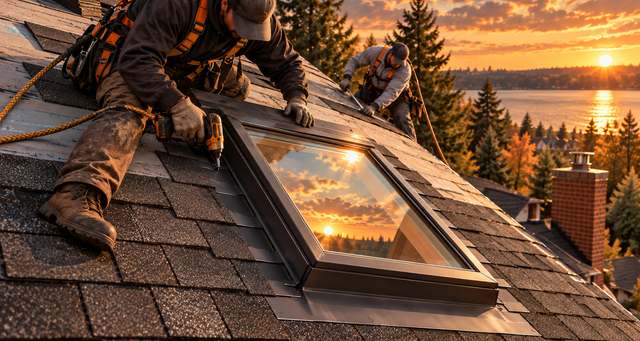
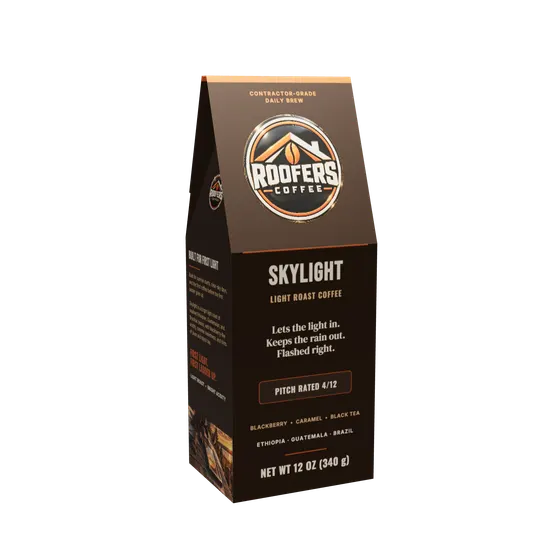
- Skylight, 4/12, light: washed coffees from Ethiopia, Guatemala and Brazil. Blackberry, caramel and black tea, bright and well-rounded.
- Low Slope, 4/12, light: Ethiopia, Mexico and Brazil. Fresh fruit and citrus with a light body, bright and lively.
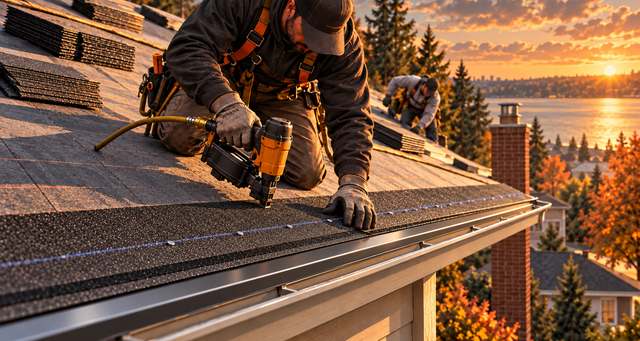
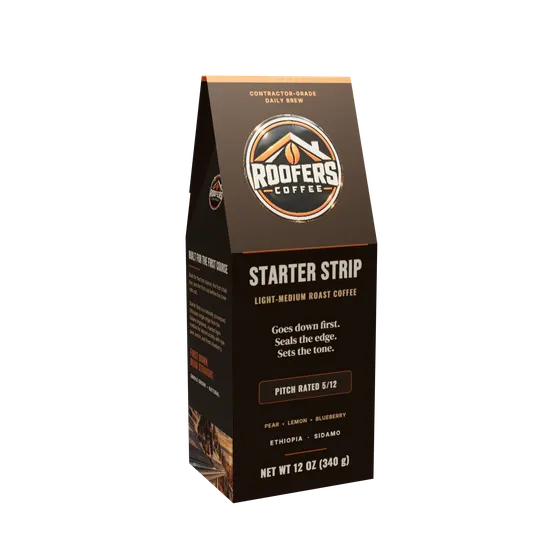
- Starter Strip, 5/12, light-medium: a single origin from Sidamo, Ethiopia, natural process. Pear, lemon, blueberry and floral notes with vibrant acidity.
- Punch List (Decaf), 7/12, medium and decaffeinated: Indonesia. Earthy, herbal and dark chocolate, with full body and low acidity.
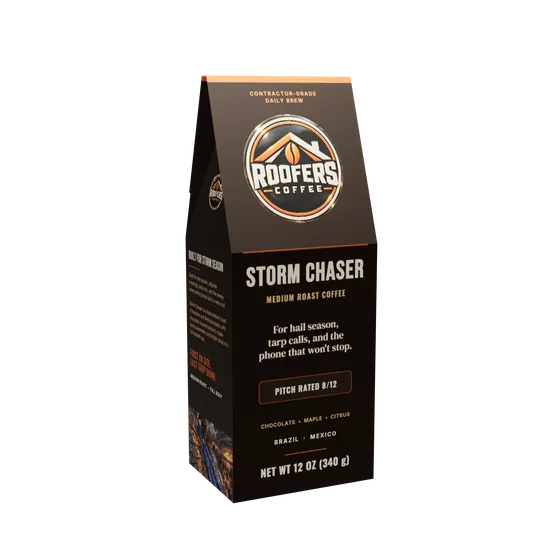
- Storm Chaser, 8/12, medium: Brazil and Mexico. Chocolate-covered almond, maple syrup and citrus, bold with a full body.
- The Tear-Off, 10/12, medium-dark: Brazil and Mexico. Cocoa and toasted nut, full body, smooth enough to drink black.
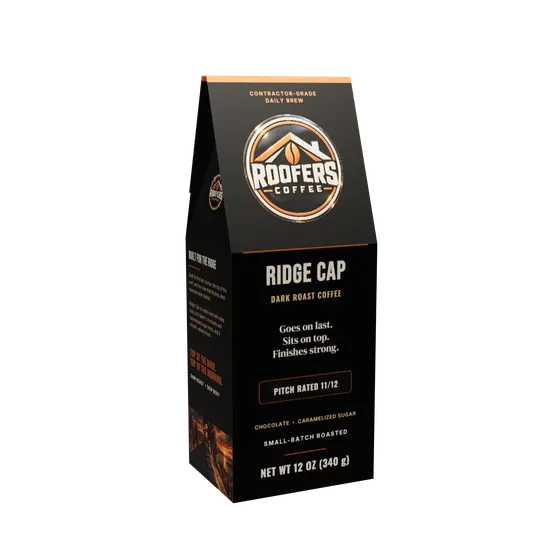
- Ridge Cap, 11/12, dark: baker’s chocolate and caramelized sugar, deep body and a smooth, velvety finish.
Every one comes in a 12 oz (340 g) box, whole bean or ground, small-batch roasted fresh when you order, for $19.95.
Picking your pitch
- Like it bright and drink it black? Start at 4/12 or 5/12.
- Want one pot the whole crew will drink? 8/12 is the middle of the roof.
- Want it bold and roasty? Go 10/12 or 11/12.
- Late shift or cutting back? Try the 7/12 decaf.
Short on time? Low Slope, Storm Chaser and Ridge Cap also come as Low Slope Pods, Storm Chaser Pods and Ridge Cap Pods. And Quick Patch Instant is rated for any pitch.