Every trade has its own shorthand, and roofing has plenty. A crew can cover squares, rakes, starter and caps before the first bundle goes up the ladder. This glossary of roofing terms is for homeowners who want to follow what their contractor is saying and for new crew members learning the trade. The roofing terminology is grouped by where it shows up, from the roof’s shape to storm work. Definitions are general. The crew lead, the manufacturer’s instructions and local code have the final word.
Basic roofing terms: roof shapes and slope
Pitch and slope
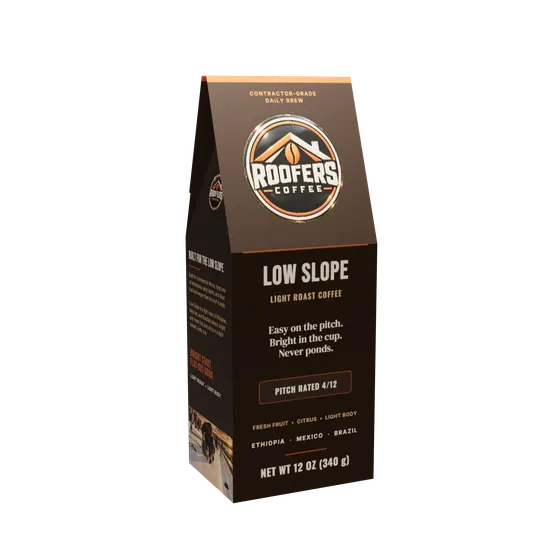
Pitch is how steep a roof is, written as inches of rise for every 12 inches of horizontal run. A 6/12 roof climbs 6 inches for every foot it runs. On most jobs pitch and slope mean the same thing, written 6/12, 6:12 or “6 in 12.” Figure yours with the roof pitch calculator, or look up degrees and multipliers on the roof pitch chart. Our coffees use the same scale on the pitch rating.
Low slope roof
A low slope roof has a gentle pitch, usually anything below about 3:12 or 4:12, depending on who draws the line. Water drains slowly, so materials matter. Asphalt shingles generally need a minimum slope of 2:12, and double underlayment is commonly required from 2:12 up to 4:12 under the International Residential Code. Local code and the manufacturer’s instructions govern. Flatter roofs usually get a membrane instead of shingles. It’s also the name of our Low Slope light roast.
Gable
A gable roof has two sloped sides meeting at a ridge, leaving a triangle of wall at each end. That triangle is the gable. It is one of the simplest roof shapes to frame and shingle. The sloped edges running up each side of the gable are called rakes.
Hip
A hip roof slopes down on all four sides, with no gable walls. The hip itself is the sloped outside corner where two roof planes meet, running from the ridge down to a corner of the house. With more edges and cuts than a gable, a hip roof usually takes more labor and material.
Dormer
A dormer is a small structure that projects from a sloped roof, with its own roof and usually a window. Dormers add light and headroom to upstairs rooms. Where a dormer meets the main roof you get valleys, sidewalls and flashing, so dormers deserve extra attention on any reroof.
Roof edges and trim
Eave
The eave is the lower, level edge of a roof, usually overhanging the wall. It is where water leaves the roof and where the gutters hang. Drip edge, starter strip and, in cold climates, ice and water shield all begin at the eave.
Rake
The rake is the sloped edge of a roof, running from the eave up to the ridge along a gable end. Rake edges catch wind, so they are usually finished with drip edge and a sealed edge course to keep shingles from lifting. Hip roofs have no rakes, only hips.
Fascia
Fascia is the vertical trim board along the eave that caps the ends of the rafters or trusses. Gutters fasten to it, and drip edge laps over its top edge. It is often wood, sometimes wrapped in aluminum or vinyl, and soft or rotted fascia is a common find during a tear-off.
Soffit
The soffit is the underside of the roof overhang, the panel between the fascia and the house wall. Many soffits are vented to pull fresh air into the attic, working with ridge or roof vents up top to move air through. Soffit vents blocked by insulation or paint can choke that airflow.
Drip edge
Drip edge is a strip of bent metal installed along the eaves and rakes. It carries water off the roof edge and into the gutter instead of letting it wick back onto the fascia and decking. A common approach is drip edge under the underlayment at the eaves and over it at the rakes, but the manufacturer’s instructions decide.
Shingle roof parts, from the deck up
Decking (sheathing)
Decking, also called sheathing, is the plywood or oriented strand board (OSB) fastened to the rafters or trusses. Older houses may have plank boards instead. Every layer above it is nailed into it. During a tear-off the crew checks for soft, rotted or delaminated sheets and replaces them, which is why estimates often price decking repairs by the sheet.
Underlayment
Underlayment is the layer between the decking and the shingles. It is a backup water barrier that keeps the deck dry while the roof goes on and catches water that gets past the shingles later. The traditional choice is asphalt-saturated felt. Many crews now use synthetic underlayment, which is lighter and resists tearing.
Ice and water shield
Ice and water shield is a self-adhering membrane, usually rubberized asphalt, that sticks straight to the deck and seals around nails. It goes where water is most likely to back up or sit: along the eaves in cold climates to guard against ice dams, in valleys, and around chimneys, skylights and pipes. Local code decides where it is required.
Starter strip shingles
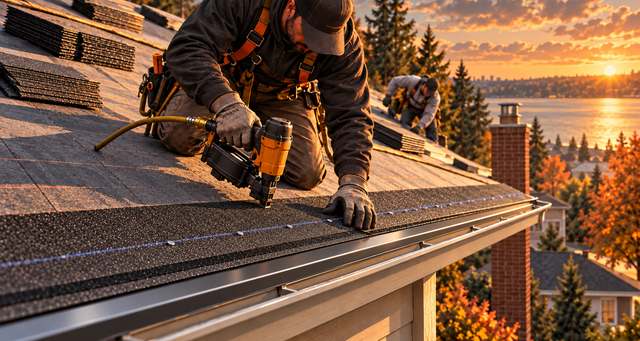
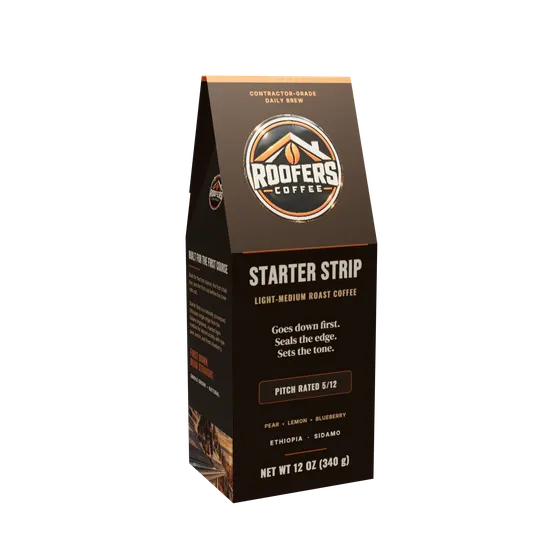
Starter strip is the first course installed along the eaves, and often the rakes, before the first visible row of shingles. It puts sealant right at the roof edge so the first course bonds down and wind cannot get under it. Crews use purpose-made starter strip shingles or cut their own. It’s also the name of our Starter Strip light-medium roast.
Ridge cap shingles
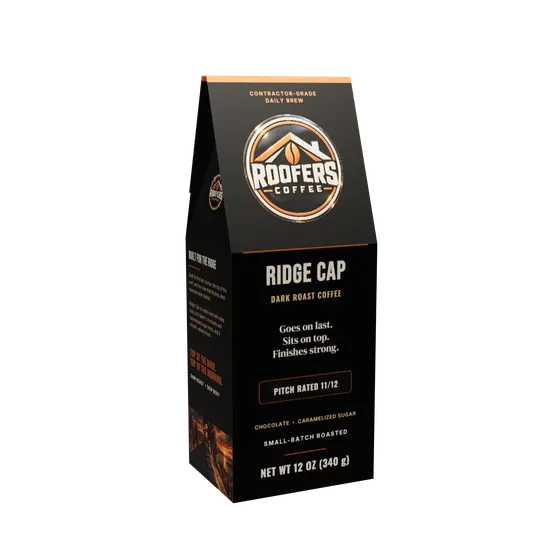
Ridge cap shingles cover the peak where two roof slopes meet, and the hips too. They fold over the ridge line to seal the joint and often sit on top of a ridge vent. Some crews cut caps from three-tab shingles; others use thicker, pre-bent caps made for the job. Ridge cap goes on last. It’s also the name of our Ridge Cap dark roast, the darkest coffee we make.
Square
A square is 100 square feet of roof surface, the unit roofers use to measure, price and order. Many standard asphalt shingles come three bundles to the square, though heavier styles can take more. Because of pitch and overhangs, roof area runs larger than the house footprint. The multiplier on the roof pitch chart accounts for that.
Where water gets tricky
Valley
A valley is the inside angle where two roof slopes meet, forming a channel that carries water off both. Because valleys move a lot of water, they are usually lined with ice and water shield first. You will hear about open valleys with exposed metal, closed-cut valleys and woven valleys.
Flashing
Flashing is the metal, or sometimes membrane, installed wherever the roof meets something else: walls, chimneys, skylights, vents and valleys. Its job is to steer water past the joint and back onto the shingles. You will hear about step flashing along sidewalls, counter flashing on chimneys and pipe boots around plumbing vents. When a roof leaks, flashing is one of the first places a roofer checks.
Skylight
A skylight is a window set into the roof plane to bring daylight into the room below. Fixed or venting, curb-mounted or deck-mounted, every skylight depends on its flashing to stay dry, so skylights get extra care on any reroof. It’s also the name of our Skylight light roast.
The job itself
Tear-off
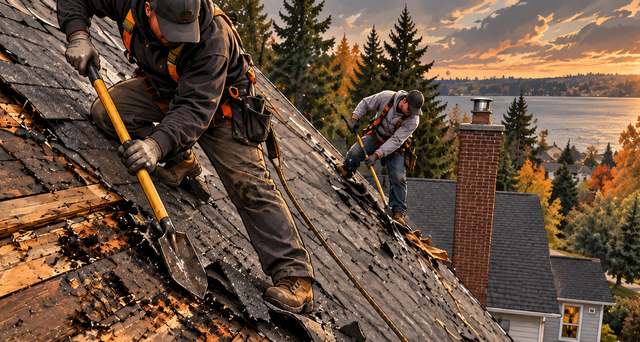
To tear off a roof means stripping the old roofing down to the decking before the new roof goes on. Shingles, nails and old underlayment go into a dumpster, and the crew runs a magnet over the yard at the end. The payoff is a bare deck the crew can inspect and repair, plus fresh underlayment and flashing. Sometimes the first layer turns out to have company underneath. It’s also the name of The Tear-Off, our medium-dark roast.
Overlay
An overlay, also called a layover or re-cover, means installing new shingles over the existing layer instead of tearing it off. It is faster and cuts disposal, but it hides the decking from inspection and adds weight. Local code decides whether an overlay is allowed and how many layers a roof can carry, and shingle manufacturers may set their own rules.
Punch list
A punch list is the short list of small items to fix or finish before a job is called done. On a roof, that might be a missed nail, touch-up paint on flashing, a downspout to reattach or one more pass with the magnet. The crew lead often walks it with the homeowner or project manager so nothing gets left behind. It’s also the name of Punch List (Decaf), our medium-roast decaf.
Storm work
Storm chaser
A storm chaser is a roofing contractor who follows severe weather from region to region, setting up wherever hail or wind has damaged roofs. The label covers everyone from established companies that travel to add crews where local roofers are booked solid to short-term operations that leave when the work dries up. Before signing with any contractor, homeowners should check licensing and insurance locally. It’s also the name of our Storm Chaser medium roast.
Emergency tarp
An emergency tarp is the temporary cover that keeps water out after storm damage until a proper repair can be made. The crew stretches a heavy tarp over the damaged area and fastens it with boards or cap nails so wind cannot peel it back. After a big storm, tarp calls tend to come in all at once.