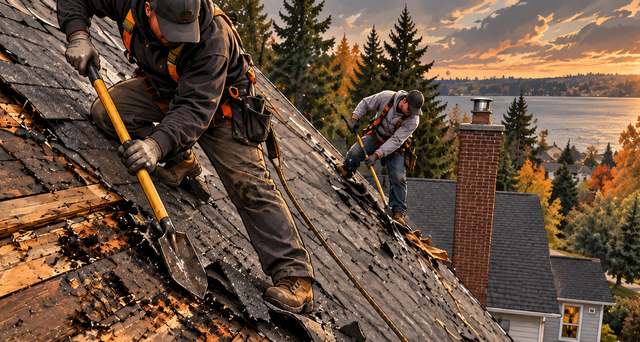
A roof pitch chart saves you from reaching for a calculator every time someone calls a roof an 8 or a 10. The chart above covers every whole pitch from 1/12 to 24/12, with the roof pitch angle in degrees, the percent grade and the multiplier for each. Below: how to read it, what the common pitches are like, and how to turn the multiplier into roof area and squares.
How to Read the Roof Pitch Chart
Each row is one pitch, written as inches of rise per 12 inches of run. Read across the row and you get three more numbers:
- Angle in degrees. How steep the roof is, measured up from level.
- Percent grade. The rise divided by the run, times 100.
- Multiplier. How much longer the slope is than its level run. It’s also the factor that turns a flat footprint into actual roof area.
The chart works backwards too. If an angle finder reads 34 degrees, run down the degrees column to the closest value, 33.69°, and read across. That’s an 8/12. For anything between rows, the roof pitch calculator gives exact figures from a rise and run or an angle, and walks through how to measure pitch in the first place.
Common Roof Pitches, Low to Steep
Residential pitches fall into rough bands. Treat these as general guidance, not hard lines:
| Pitch range | Angle | Multiplier | General guidance |
|---|---|---|---|
| 3/12 to 4/12 | 14.04° to 18.43° | 1.031 to 1.054 | Low. At or near low-slope territory, depending on who’s defining it. |
| 4/12 to 9/12 | 18.43° to 36.87° | 1.054 to 1.250 | Conventional. Easier going at the low end, more care toward the top. |
| 9/12 and up | 36.87° and up | 1.250 and up | Steep. Roof jacks and fall protection are part of the setup. |
Pitch also decides what goes under the shingles. Asphalt shingles generally need a minimum slope of 2:12, with double underlayment commonly required from 2:12 up to 4:12 under the International Residential Code. Local code and the manufacturer’s instructions govern.
Four pitches worth knowing by heart:
4/12 Pitch Roof: 18.43 Degrees
- Angle: 18.43°
- Percent grade: 33.3%
- Multiplier: 1.054
A 4/12 roof rises 4 inches for every foot of run. It sits at the low end of conventional, right around the line where some people start calling a roof low-slope. It’s one of the easier pitches to work on, though dew and frost can still make it slick.
The multiplier barely moves the number: 1,000 square feet of footprint is about 1,054 square feet of roof, or 10.5 squares. Since 4/12 sits at the top of that 2:12-to-4:12 band, confirm the underlayment call with local code and the manufacturer before you order.
6/12 Pitch Roof: 26.57 Degrees
- Angle: 26.57°
- Percent grade: 50%
- Multiplier: 1.118
A 6/12 roof rises half a foot for every foot of run, which keeps the math friendly: the grade is exactly 50 percent. It sits squarely in the conventional range, but footing takes more attention than on a 4/12, especially on a damp morning or over loose granules.
A 1,000-square-foot footprint becomes about 1,118 square feet of roof, or 11.2 squares. A 12-foot run measures about 13.42 feet along the slope.
8/12 Pitch Roof: 33.69 Degrees
- Angle: 33.69°
- Percent grade: 66.7%
- Multiplier: 1.202
An 8/12 roof climbs two-thirds of a foot for every foot of run. It’s toward the steep end of conventional. Whether it’s walkable is a judgement call for the crew and the conditions, so plan for roof jacks and fall protection.
The multiplier jumps to 1.202. A 1,000-square-foot footprint needs about 1,202 square feet of roof, or 12.0 squares, a little over 20 percent more roof than footprint.
12/12 Pitch Roof: 45 Degrees
- Angle: 45.00°
- Percent grade: 100%
- Multiplier: 1.414
A 12/12 roof rises a foot for every foot. Rise equals run, so the angle is exactly 45 degrees. That’s steep work: roof jacks, planks and fall protection, and every task takes longer.
It eats material, too. The multiplier is 1.414, the square root of 2, so 1,000 square feet of footprint takes about 1,414 square feet of roof. That’s 14.1 squares, roughly 41 percent more roof than footprint.
Roof Pitch vs Roof Slope vs Roof Angle
These terms get swapped around on jobsites, in codes and in product instructions. Here’s how they line up:
- Pitch usually means rise per 12 inches of run: 6/12, 6:12 or “6 in 12”.
- Roof slope is the same ratio. Building codes and shingle instructions tend to call it slope and write it as 6:12.
- Angle is the same steepness in degrees, measured up from level.
- Percent grade is rise over run times 100. It’s more at home on ramps, driveways and drainage than on roofs, and 100 percent is 45 degrees, not vertical.
One wrinkle if you read older carpentry books: pitch sometimes meant rise over the full span of the building, not the run. By that definition, a 6/12 roof is a 1/4 pitch (6 inches of rise over a 24-inch span), and an 8/12 is a 1/3 pitch. If an old plan lists pitch as a fraction like 1/4, that’s what it means.
Converting Degrees Back to Roof Pitch
To turn an angle into a pitch, use rise = 12 × tan(angle).
- 40 degrees: tan(40°) = 0.839, and 0.839 × 12 = 10.07. Call it a 10/12.
- 20 degrees: tan(20°) = 0.364, and 0.364 × 12 = 4.37. That falls between a 4/12 and a 5/12.
When the answer lands between whole pitches, like the 20-degree example, either the roof really is an odd pitch or the reading is off. Measure again before you commit to an order or a price.
Using the Multiplier to Estimate Roof Area and Squares
- Measure the roof’s footprint, overhangs included. That’s the plan area.
- Find the multiplier for your pitch in the chart.
- Multiply the plan area by the multiplier to get the roof area.
- Divide by 100 to get squares. One roofing square is 100 square feet.
Say the footprint is 48 by 32 feet, or 1,536 square feet, and the roof is an 8/12. That’s 1,536 × 1.202 = 1,846.3 square feet of roof, or about 18.5 squares. Add waste and accessories on top, the way you normally figure them.
The multiplier assumes every plane shares the same pitch. If the main roof is 8/12 and the porch is 3/12, figure each section with its own multiplier and add them together.
Pitch on the Roof, Pitch in the Cup
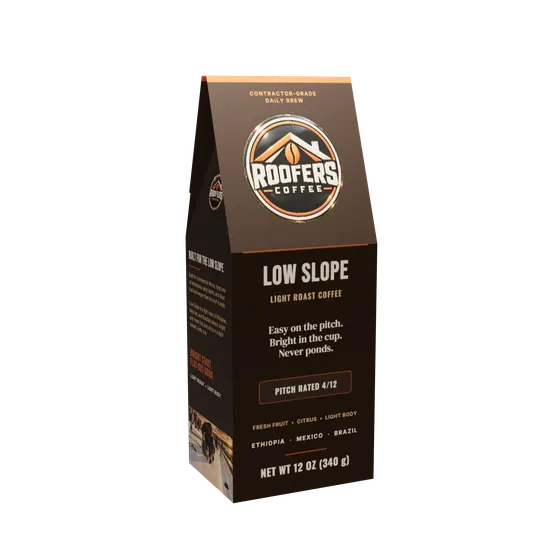
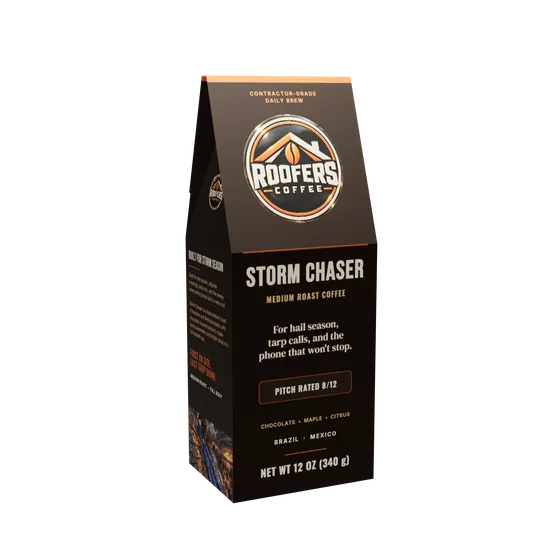
Our roast scale borrows the same idea. The ROOFERS COFFEE pitch rating runs from light at 4/12 to dark at 11/12. The higher the pitch, the darker the roast and the bolder the cup:
- 4/12: Skylight and Low Slope, light roasts
- 5/12: Starter Strip, light-medium
- 7/12: Punch List (Decaf), medium, decaffeinated
- 8/12: Storm Chaser, medium
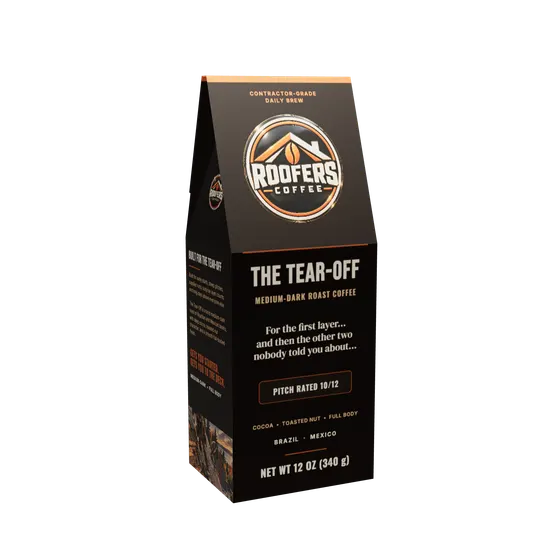
- 10/12: The Tear-Off, medium-dark
- 11/12: Ridge Cap, dark
It rates roast, not slope, so there’s no multiplier to run. The steepest one still doesn’t need roof jacks.